Thursday, 6 October 2011

Richmond park deer rut - Part 1

This past Sunday, I did something I haven't done in 6 years of living in south west London; I went to Richmond park to see the deer rut. Now granted, I have a little more interest in it now than perhaps I did when I first moved here, as I am now a keen wildlife photographer, but honestly, photography or not, I can't believe I haven't gone before.


For those who don't know, the deer rut is an annual event for all types of ruminant animals, of which red and fallow deer, the two species found in Richmond Park, belong. The rut in many species is triggered by a shortening of the length of daylight hours each day so, in the UK, it is usually over September and October. During this time the males, or stags, have one thing and one thing only on their mind; women. The females, or hinds, only come into season once a year and for a very short period of time so the stags do their best to maintain control over a group of females so he and only he can breed with them. The stags do not eat at all during this period and often lose up to 20% of their body weight by the end of the rutting season.


During this time, the biggest and strongest stags constantly bellow an echoing roar to other stags, telling them to stay away, and also to the hinds, to attract them. After all, the hinds want to mate with the biggest, strongest stags. In my opinion, the roar of a red deer sounds something like a cow mooing whilst burping at the same time. I recorded the following video to show what it's like.


If other stags don't get the hint and decide to come too close to the dominant stags group of hinds, the dominant stag will attempt to chase the contender off. Inevitably, however, fights do break out which can lead to some incredible scenes of clashing antlers.

The way two stags of equal size square up for a fight, generally follows this pattern of behaviour;  Two stags bellow and roar to each other, both trying to exert their dominance over the other.


If that doesn't cause one to back down, they will parallel walk. This is exactly as it sounds; the two stags walk up and down in parallel, sizing each other up.


If neither stag will back down after this, that's when antlers clash. This clashing can be quick or it can be lengthy and bloody.


Within Richmond park, there are two types of deer; red and fallow. All photos on this page, apart from the next one, are of red deer. The fallow deer are smaller than the reds, have spots on their backs and have thicker antlers.  Male fallow deer are called bucks instead of stags and the females are called doe.


Red deer do a lot to attract hinds. Not only do they roar and fight with other stags but they also cover themselves in their urine, as it contains powerful pheremones; it can be quite over-powering. The also like to wallow in mud, as this guy had just done.


And, obviously, it's all about the accessories, and accessories for a red deer stag is ferns and bracken in their antlers.


It wasn't all about deer though and I managed to see something I had wanted to but never quite managed; to see one of the parks Ring-necked Parakeets appearing from a nest hole. This one posed quite nicely for me.


It was the deer I had come to see, however, so that's what I saw. I'm not going to lie, the guy in the next photo nearly made me mess myself. I was cutting through one of the tracks in the bracken (in hindsight, not the best idea) and, as I approached a better established path, I spotted this guys antlers about 2 metres away from where I was standing. With this, I decided it might be an idea to run a little further away from him. Fortunately for me, it was a very hot day and I don't think he could be bothered to be too worried about my presence.


One very important note on the deer rut; these are WILD ANIMALS! It amazed me the stupidity of the behaviour of some groups of park users, including a family quite happy to have their kids, no older than 6 or 7 years old, running up within a few metres of a group of fallow deer, trying to get a photo.


Again, they are wild animals, they haven't eaten for weeks and will think of anything getting too close as a challenger. If you don't believe me, maybe find this woman and ask her what she thinks; http://www.bbc.co.uk/news/uk-england-london-15077514 For goodness sake, they've been known to attack cars!


It was wonderful to see this spectacle of nature, and right on my doorstep.


I shall be there again this weekend and this time my girlfriend, Kelly, will be there to witness it as well. Here's hoping for some dry weather again!

Tuesday, 27 September 2011

Technical Wildlife Photography Workshop, with Mark Carwardine

This Saturday I attended a Technical Wildlife Photography Workshop, at the Wildfowl and Wetlands Trust in Barnes, with Mark Carwardine. Having had an interest in wildlife photography for some time and nature documentaries pretty much since the advent of the Discovery Channel on Sky, I was very aware of Mark's work. The opportunity to meet and learn directly from him was an incredible. His photos are amazing and that level of photography is very much where I aspire to.


The aim of the course, as the course suggests, was aimed at the more technical aspects of wildlife photography once you have taken the shot. This includes how to choose your best shots and the work-flow necessary to touch up and make the very best out of the images you have captured.


To start, Mark walked us through his standard work-flow, giving us practical advice on what software he used and how he used it. Although I already had a work-flow for my images in place, I have to admit that it has changed slightly and I'm very pleased with the results so far from doing so.


Mark continued, explaining his standard camera set-up and why he set it up this way. I was pleased to hear that this is very much the same as I set up mine. Once you have the set up, you just need to practice with your camera so that changing functions and settings becomes second nature, meaning you won't miss that once in a lifetime shot because you're busy changing the focussing point.


Following lunch, it was time for a practical session. It was great to go out in a group and have the advice of Mark as we were snapping away in the sun, although I must admit I did feel slightly pressurised to take a good shot.


While outside, we were able to meet up with Laurence Arnold, one of the reserves volunteers and, as we were told, a self confessed reptile addict. He was able to take us to a few places in the reserve not usually seen by the visitors and he was able to show us Slow Worms...


... and a Grass Snake.


Once back in the classroom, the subjects covered were entering a competition and giving yourself the best chance of doing well in it, and signing up to and selling your images through a stock agency. These were of great interest to me as I would sincerely love to be able to make a living from my nature photography. There's lots to look at but with Mark's advice I am at least on the right track.

Sunday, 25 September 2011

France - Red Squirrels stealing walnuts

Another highlight from our holiday in France was to be found, again, at the bottom of the garden - Red Squirrels. Another first for me and being able to stand at the bottom of the garden and see them running across the branches of the trees was fantastic.


Beginning their winter preparations, they were leaping from the oak trees over to a walnut tree...


... and returning with a mouthful of walnuts, taking them back to hide in their larder.


Not all of the walnuts necessarily made it back to the larder though.


I was amazed at how close I could get to this one, totally engrossed in its tasty treat. I was standing directly beneath, with it only a couple of metres above me.

France - Wild birds and guns

As well as the animals at the house itself, the area was full of bird life - it was great.

One of the main features of the area is the Etang de Saint-Estephe, a man-made reservoir just outside the village. The day we walked around, it was slightly overcast and there wasn't that much about. However, walking past a pine tree, I noticed is was absolutely alive with House Martins, busy feeding on the seeds within the pine cones.


As we continued our walk, I spotted a Pied Flycatcher sitting on a branch. This was rather nice, as I'd never seen one before, not that I realised what it was until I got home.


This was obviously a day for firsts as we also spotted a Willow Warbler towards the end of our circuit of the reservoir. Again, another first time spot.


As well as birds, there were lizards. This little guy, a Common or Viviparous Lizard, was spotted warming himself as best he could on a tree stump.


There was also plenty of wildlife to be found back at the house. A number of bird feeders were attracting incredible numbers of Great Tits...


... as well as Blue Tits.


A couple of the bushes next to one of the barns was attracting a large number of House Sparrows.


The bees were attracted to all the flowers in bloom, including this Carpenter Bee.


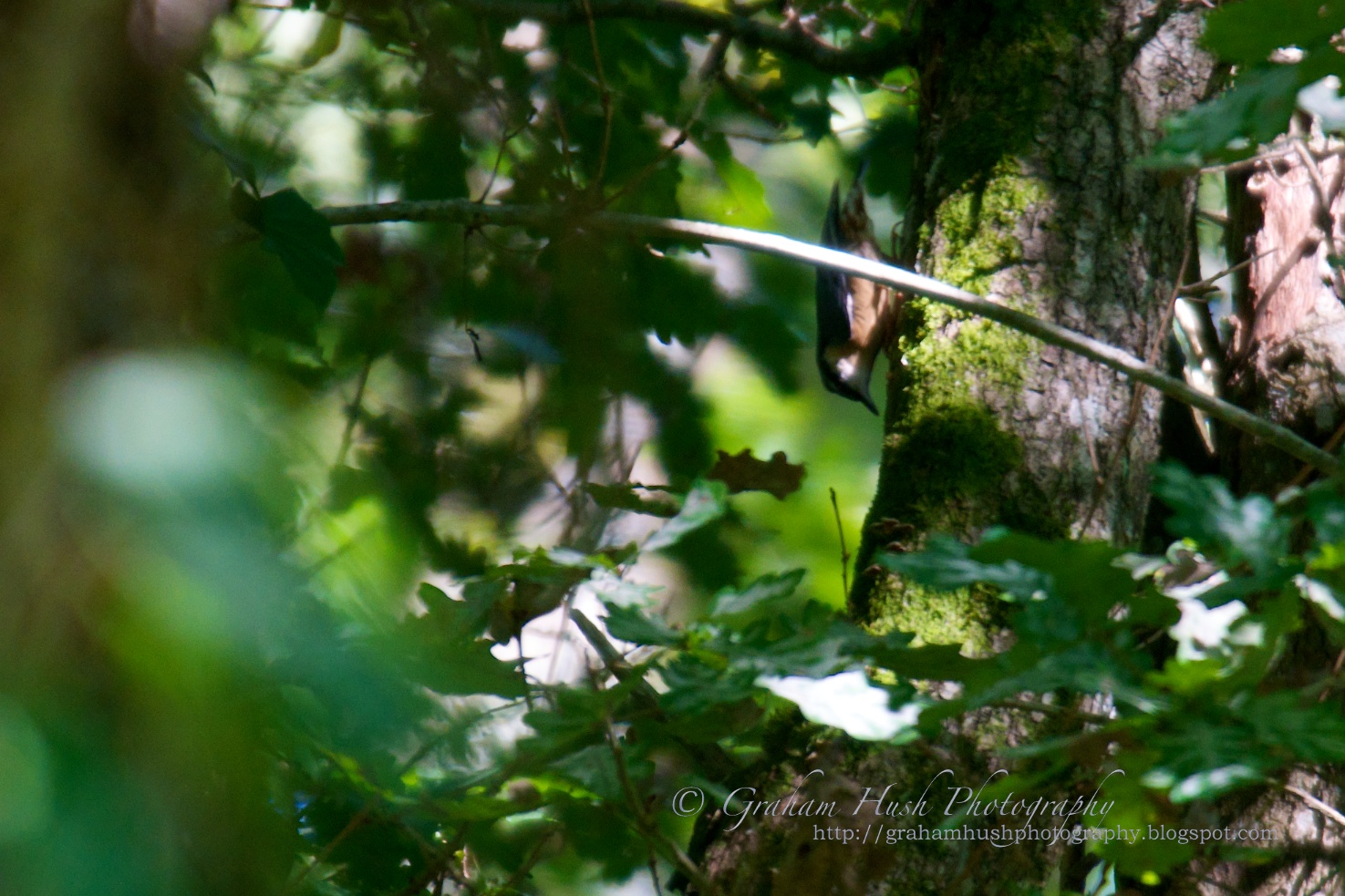
In the woodland to the rear of the house there are Woodpeckers, Great-spotted, Green and Grey-headed are all to be found, as well as this, which I actually thought was a woodpecker at first, a Nuthatch.


The surrounding area is mainly wood and farmland. This gives the perfect habitat for Buzzards. This one below could be found, a lot of the time, sitting on one of the fence posts of a field we regularly drove past. Unfortunately it was a fence post at the opposite side of the field.


Another experience we had was of "La Chasse à Courre", or hunting with hounds, in this instance for Wild Boar and Deer. This is is perfectly legal when done right but no less scary with gun shots going off in the field next to you and the barking of the pack of hounds echoing around the countryside - especially when there are two domesticated pigs in the garden!

Monday, 19 September 2011

Brantôme, France - Sun and a Kingfisher

While in France, we were recommended to pay a visit to a local town called Brantôme.

Brantôme is encircled by a sweep in the river Dronne, is home to a Benedictine abbey and was originally founded in 769. There is no doubt that Brantome is very beautiful, even if it was overcast and drizzling the first time we visited.  It is what I imagined a "typical" Dordogne town to be. Forgetting about the weather, we had a wander around the town. We managed to find a nice little cafe and using my very rusty French managed to successfully order some food, followed by a waffle with chocolate sauce and whipped cream for dessert.  Delicious.


Kelly spotted some aquatic life which we later managed to identify as a Ragondin, also known to non-French speakers as a Coypu. Unfortunately, on this occasion, I didn't have my big lens with me so this is the closest shot I could get of it.


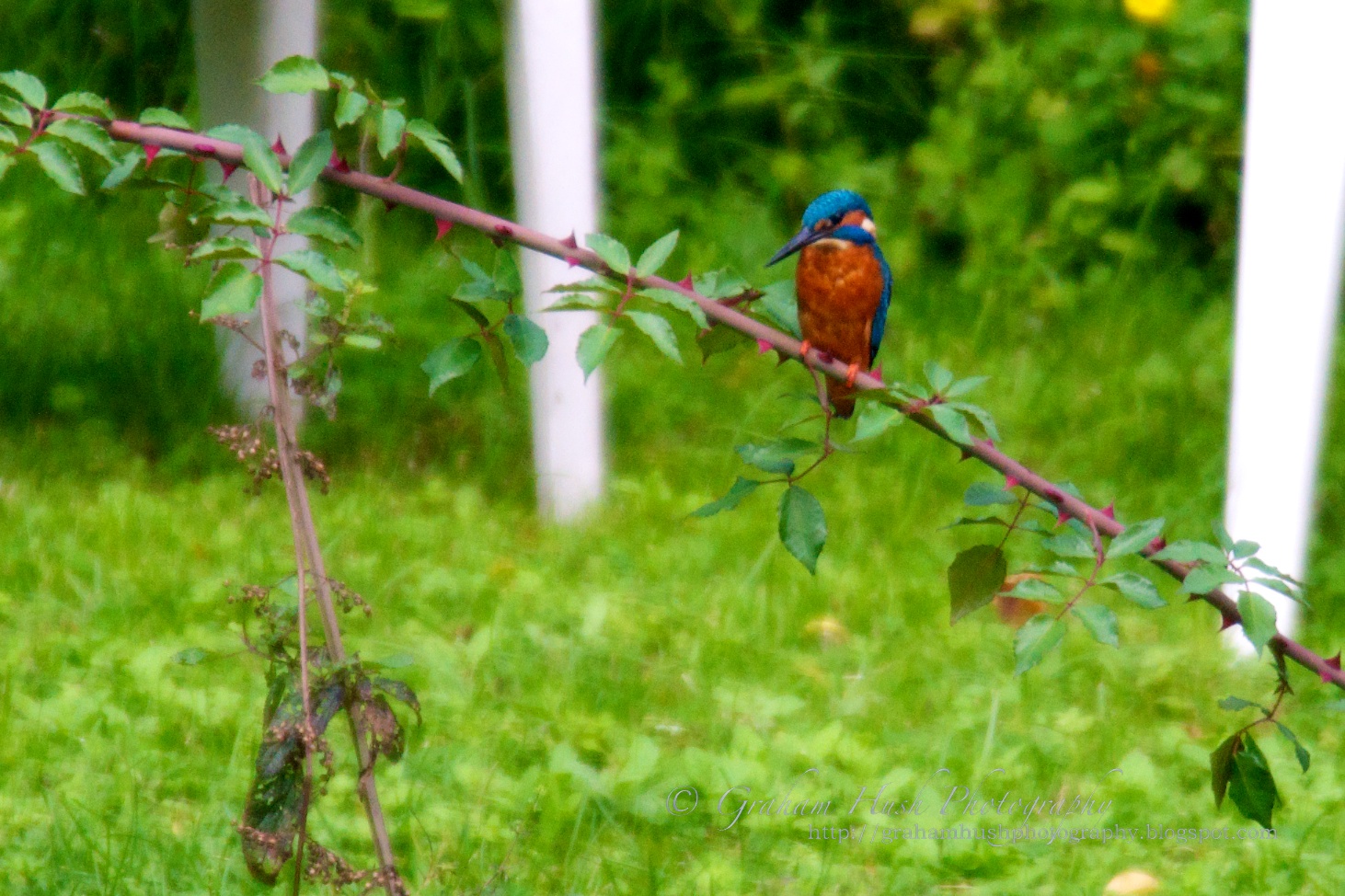
The second time we visited turned out to be an afternoon for wildlife rather than the gift shops we had originally gone for. This was mainly due to the fact that, as soon as I'd got out of the car, a Kingfisher decided to show himself on the opposite side of the river. This time I did have my big lens with me and the sun was shining, affording Kelly and I an opportunity to sit and watch him fishing. He was absolutely gorgeous.


Granted, the Kingfisher wasn't going for the subject of my next photo but it was very clear to see how clean and healthy the Dronne is from the amount of fish, both small and large, to be seen.


Whilst walking up to the abbey I spotted a Hummingbird Hawk-moth. This was fantastic to see, as Kelly's aunt had mentioned that they're regularly spotted back at the house. It was amazing to see it flying from flower to flower, not once stopping for a rest. As an aside, the next photos were taken with a shutter speed of 1/250 sec, showing just how quickly those wings are moving. I later found out their wings beat at 85 beats per second.


It looks as though the spiders had been busy as well.

Related Posts Plugin for WordPress, Blogger...